
A Different Kind of Lent
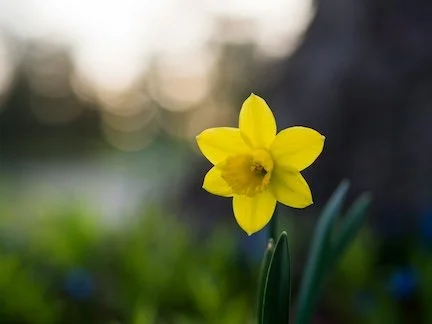
Each year as winter loosens its grip and the first daffodils begin to bloom, the Christian church enters the season of Lent. The word Lent comes from the Old English lencten, meaning “springtime” or “lengthening of days.” Traditionally, Lent marks the 40 days leading up to Easter -- a season of repentance and preparation that mirrors Jesus’ 40 days in the wilderness (see Matthew 4:1–11).
Some Christian communities follow the church calendar closely, with fasting practices, prayer services, and Ash Wednesday celebrations, while others hold the season more loosely. In many Presbyterian congregations, Lent is less about rules and more about an invitation: a space in the year to pause, notice, and realign our hearts with Christ.
Few writers captured this spirit of thoughtful reflection quite like Madeleine L’Engle. Many know L’Engle as the beloved author of A Wrinkle in Time, the novel that introduced generations of readers to Meg Murry, Charles Wallace, and the mysterious Mrs. Whatsit. Yet L’Engle was also a lifelong Christian whose writing -- fiction, essays, and poetry -- often explored faith, doubt, grace, and the mystery of God’s presence in ordinary life. Her work reflects a deep conviction that faith is not rigid or mechanical; instead faith is lived, questioned, and discovered again and again.
In 1966, L’Engle published a poem that offers a refreshing vision of Lent:
For Lent
It is my Lent to break my Lent,
To eat when I would fast,
To know when slender strength is spent,
Take shelter from the blast
When I would run with wind and rain,
To sleep when I would watch.
It is my Lent to smile at pain
But not ignore its touch.
It is my Lent to listen well
When I would be alone,
To talk when I would rather dwell
In silence, turn from none
Who call on me, to try to see
That what is truly meant
Is not my choice. If Christ’s I’d be
It’s thus I’ll keep my Lent.
L’Engle’s poem seems backward, doesn't it? Instead of giving something up, she speaks of eating when she would fast. Instead of pushing herself harder, she acknowledges when her strength is thin and chooses rest. Instead of withdrawing into silence, she turns toward those who call.
But there is a humility -- and a little Romans 10 -- in L'Engle's poem: Her vision of Lent is not about proving spiritual strength. It is about honesty. It is about learning, day by day, what it means to belong to Christ.
What if the invitation of Lent is not to add more strain, but to pay attention -- to our limits, to the needs of others, and to the gentle voice of God that so often speaks in ordinary moments? This year, what if we follow L’Engle’s wisdom? What if we eat when we should fast? What if we recognize when slender strength is spent? What if we smile at pain without pretending it does not exist? And what if we choose, as she writes, to “listen well… turn from none who call on me”?
Because in the end, the heart of Lent is not discipline for its own sake. The heart of Lent is remembering whose we are.
“If Christ’s I’d be,” L'Engle writes.
And there is the most important Lenten practice of all: living each day with the quiet confidence that we belong to Christ.