
The Courage to Intervene
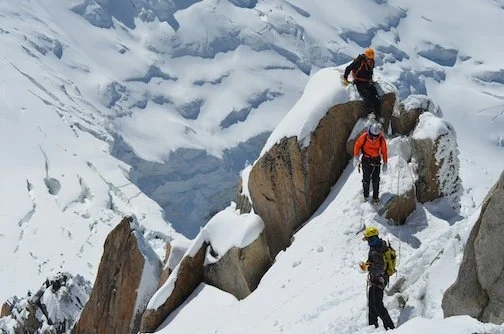
High on a mountain peak, danger does not always announce itself with drama. Sometimes it unfolds quietly, in slow motion -- wind rising, snow blinding, a single misstep on treacherous ice.
Madalin “Cris” Cristea was descending the mountain with two strangers when he saw it happen. Through the blur of white, a British climber named James slipped and began sliding uncontrollably down the slope. James was roped to his adult son, Matt. If one went over the edge, the other would almost certainly follow.
“I was in a state of shock,” Cris later said. “I just had this feeling that he was going to die.”
For a moment, Cris froze. Visibility was poor. The wind drowned out all sound. They were alone, high on Mont Blanc without a guide and without help in sight. Then instinct took over. Cris leaped toward the rope, landed hard on his stomach, drove his ice axe into the ice, and dug his crampons into the slope. His arm wrenched violently as the rope went taut. Then -- stillness.
The fall stopped.
James was left clinging to the slope mere feet above a sheer drop. Matt stood above them, frozen in terror. Moments later, other climbers appeared and helped pull James to safety. No one was seriously injured. But everyone knew how close they had come to catastrophe.
What makes this story linger is not just the courage of a rookie climber acting without hesitation. It is the clarity of the moment. Cris did not have time to calculate outcomes or protect himself first. He did not pause to ask whether this was his responsibility. He simply acted, placing his own body between two men and a deadly fall.
That kind of clarity feels rare right now -- and dangerous.
In a time marked by violence, fear, and rising division, it can be easier -- and safer -- to stay quiet. To look away. To tend quietly to the wounded after the damage has already been done. But history, and faith, keep pressing a harder question: What does it mean to act when the danger is still unfolding?
The German pastor and theologian Dietrich Bonhoeffer, who resisted Hitler’s regime and ultimately lost his life for that resistance, put it this way in his collection A Testament to Freedom: “We are not to just bandage the victims under the wheel, but to jam a spoke in the wheel itself."
Bonhoeffer was not dismissing compassion; he was insisting that compassion must go further. Bandaging victims matters. Caring for the wounded matters. But there are moments when faith demands intervention, when love requires risking comfort, reputation, or safety to stop the harm at its source.
On Mont Blanc, Cris did not merely help James after the fall. He stopped the fall itself. He jammed a spoke in the wheel.
Not everyone is called to a mountain ridge. But everyone is called to attentiveness: to notice when someone is slipping, when systems are harming, when silence becomes complicity. Sometimes faith looks like quiet care; other times it looks like decisive, costly action.
As we move through a season marked by fear and fracture, may we be people who do more than tend wounds after the fact. May we pray for the courage to see clearly, to move decisively, and -- when the moment demands it -- to put our weight against the wheel.
Because sometimes love is not gentle. Sometimes love grabs the rope, digs in, and refuses to let another life slide away.