
Finding Hope in the Flames
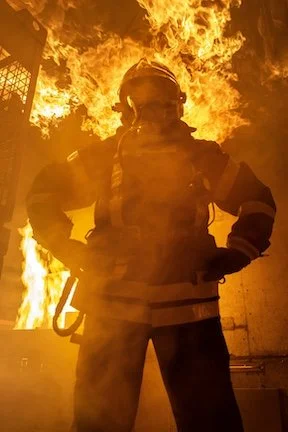
Terry McCarty remembers lying on a Nevada sidewalk at six years old, wrapped in a sleeping bag and staring through darkness toward a fire station across a dirt lot. He remembers seeing the bay doors fly open and the fire engines rushing toward him. And he remembers thinking -- clearly, unmistakably -- Help is on the way.
Terry does not know whether that moment truly happened or whether his traumatized mind created it. What he does know is that the memory carried him through the worst fire imaginable.
In 1992, Terry’s older brothers were experimenting with kerosene in a dog bowl -- curiosity clearly outpacing their understanding. When the bowl ignited, one panicked kick sent flaming fuel straight into Terry’s chest. The fire wrapped around him “like a wet blanket,” burning 73 percent of his body. Terry says he did not realize he was on fire at first; he thought the world was on fire. Next came the pain, and then the sound: deafening, like standing inside a roaring bonfire.
Stop, drop, and roll did little against kerosene. What saved him was a neighbor who tackled him and smothered the flames with a sleeping bag. It was an ordinary object, still in the car from a recent camping trip, and it became the difference between life and death.
Terry spent the next year in hospitals. He was airlifted to Las Vegas, then transferred to Galveston for specialized burn care. He endured repeated debridement procedures -- burned skin scrubbed away to prevent infection -- flatlined multiple times, lost fingers, and lived under waves of pain medication and medically induced comas. He later said the fire itself was not the worst part. What came after the fire was harder.
Eventually, he returned to school in a completely different body, wearing medical garments and splints, learning how to live inside skin that no longer felt like his own. Childhood curiosity turned into teenage cruelty. Junior high was a battlefield. As he grew older, strangers saw a victim before they saw a person. Employers dismissed him as a liability. Even small dreams felt fenced in by other people’s assumptions.
Then one day, at age 24, a manager rejected him on sight. And something in Terry snapped -- not in anger, but in resolve. Terry decided that if the world insisted on labeling him, he would choose a better word: Not victim. Survivor.
Against all odds, Terry applied to become a volunteer firefighter. He failed the physical agility test twice -- once by four seconds and once because his sweatpants literally would not stay up. On his third attempt, he passed with one of the fastest times that season. Two weeks later, he entered fire academy.
Training forced him to face the very thing that had nearly killed him. During a live fire exercise, flames rolled across the ceiling toward him, mirroring the kerosene rushing toward his six-year-old body. For a split second, Terry froze. And then the fire passed over him.
He realized he was protected. He had gear. He had training. He had tools. And the fear dissolved as the flames moved on. Terry later said it felt as though the fire itself took something heavy from him that day: something that he had carried for decades.
Although he eventually stepped away from firefighting, the academy became a turning point. Terry now works with nonprofits that support burn survivors, speaks to firefighters about trauma, and helps bridge the gap between those who fight fires and those who survive them. His life is not defined by the accident, though the scars remain. And his family remains close, especially his brothers. “There was nothing to forgive,” Terry says. “We were kids.”
And that memory of lying on the sidewalk confident that help was on the way still matters. Real or imagined, it planted a hope in him that refused to let go: a quiet conviction that suffering would not have the final word. That belief carried him through pain, recovery, rejection, and fear, shaping a life marked not by what was lost, but by what endured.
The Book of Romans echoes that promise: “For I am convinced that neither death nor life, neither angels nor demons, neither the present nor the future, nor any powers, neither height nor depth, nor anything else in all creation, will separate us from the love of God that is in Christ Jesus our Lord" (Romans 8:38–39).
Facing our worst fears is not about overcoming them, but about trusting that God's love remains stronger than the fire, stronger than the trauma, stronger than the past.
For anyone walking through fear today, may this truth hold you fast: Nothing can separate you from God’s love -- and nothing you face is faced alone.